The EE4HORECA Sustainable Business Model is a practical framework designed to help businesses and other stakeholders understand how their activities affect energy use, costs, and sustainability across the entire value chain. It helps identify what is working well, where challenges exist, and where improvements can be made, while showing how changes in one part of the chain can influence overall performance. Because the framework is flexible, organisations of different sizes and levels of experience can adapt it to their own reality.
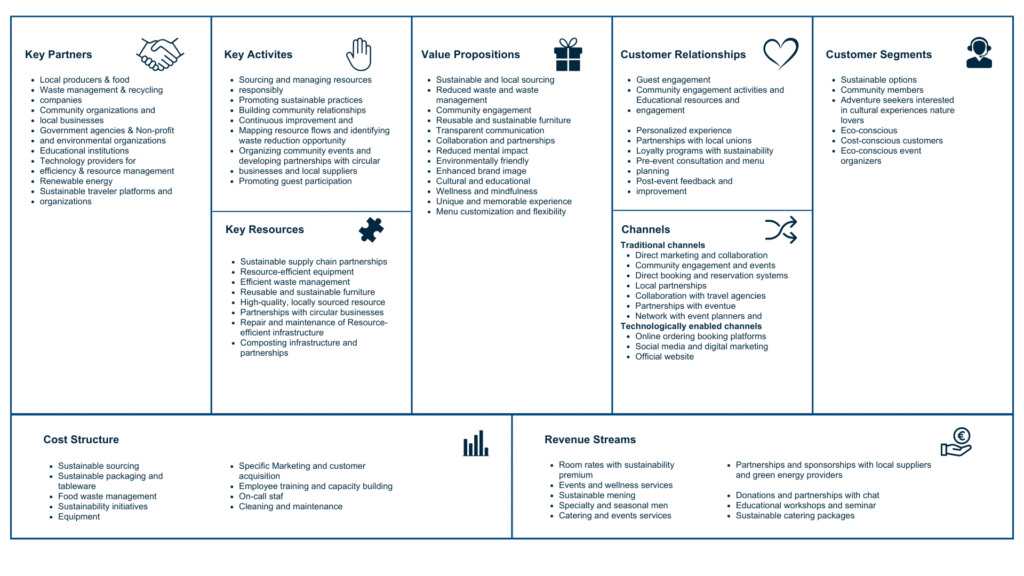
The framework brings together several complementary tools that guide stakeholders step by step on their journey towards greater energy efficiency and sustainability. It starts with the sustainable business model, which provides a strategic overview of how sustainability can be embedded into the way value is created, delivered, and captured all within a single business and across its wider value chain.
Building on this strategic view, the benchmark energy assessment tool helps users take a closer look at how energy is actually used along the value chain. It allows stakeholders to analyse energy consumption overall and at each key step, including the types of energy used. By comparing these results with benchmark data, businesses can see how they perform compared to good practices in the sector. This makes it easier to spot where energy efficiency efforts would have the greatest impact, whether by focusing on high-consumption activities or on areas that lag behind best practice.
To support sound investment decisions, the life cycle costing model looks beyond upfront costs. It helps assess the full cost of energy efficiency solutions over time, including operation, maintenance, and end-of-life costs. In parallel, the non-energy benefits model captures additional advantages that energy efficiency measures can bring, such as improved comfort, reduced risks, better working conditions, or a stronger business reputation.
Together, these tools create a clear and logical pathway: from strategic thinking, to technical and financial analysis, to a broader understanding of value creation. This integrated approach helps stakeholders make informed, balanced, and collaborative decisions that support long-term sustainability and energy-efficient business models.