Austria’s hospitality sector is making significant progress towards sustainability, but important challenges remain. Hotels are under increasing pressure to reduce their environmental footprint while maintaining competitiveness, particularly as investments in sustainable value chains—such as sourcing regional and organic products—often come with higher costs that guests are not always willing to absorb. Supporting businesses through this transition requires practical guidance, clear standards and collaboration across the sector.
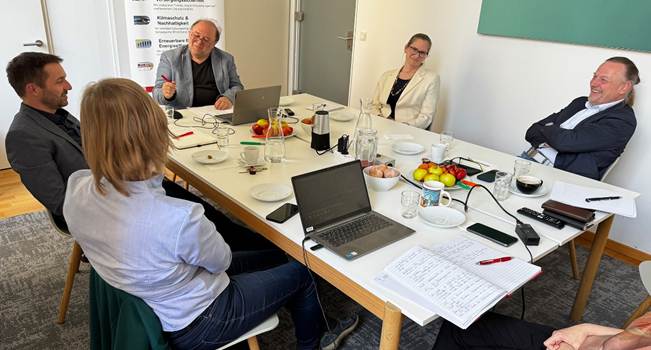
As part of the LIFE EnergyEfficiency4HORECA project, the Energy Institute for Business (EIW) brought together leading experts from the Austrian Energy Agency, the Federal Ministry for Climate and Environmental Protection, the Austrian Hotel Association and independent energy consultants to discuss practical pathways towards sustainable tourism. The discussion highlighted the complementary support available to hotels through energy advice, funding opportunities, environmental certification schemes and technical expertise. Participants also stressed that engaging staff and building a sustainability culture are just as important as investing in new technologies.
The roundtable showcased practical examples from Johannes Scheiblauer, Regional Chair of the Austrian Hotel Association for Lower Austria and owner of the Relax Resort Kothmühle and Schloss an der Eisenstraße. His hotels have implemented a wide range of energy efficiency measures, including LED lighting, variable-speed pumps, biomass heating, photovoltaic systems and environmental certifications, with an air-source heat pump planned as the next step. Recognising that transport is a major source of emissions, the hotels also encourage guests to travel more sustainably by offering an electric shuttle bus linked to public transport.
Austria’s hospitality sector has achieved significant improvements in energy performance over the past decade. Between 2013 and 2023, energy consumption in accommodation facilities fell from 14.7 to 6.3 kWh per overnight stay, while the accommodation and catering sector reduced consumption from 36.1 to 31 kWh. These improvements have been so substantial that existing national energy benchmarks, developed by the Austrian Energy Agency and EIW in 2021, now need to be updated to reflect the sector’s progress.
One of the key outcomes of the EnergyEfficiency4HORECA roundtable was a shared commitment to develop new energy benchmarks for Austria’s hospitality sector. Bringing together policymakers, industry representatives and technical experts demonstrated the value of collaboration in accelerating the transition towards more sustainable tourism and providing businesses with clear targets for continuous improvement.
© Oliver Dworak (EIW)