Business Models and Benchmarks
This activity focuses on helping HORECA businesses understand how sustainability and energy efficiency can be embedded into their business models and daily operations.
The project analyses how resources and energy flow along the HORECA value chain, identifying best practices that improve environmental performance while supporting economic viability. Rather than looking at energy use in isolation, this work adopts a life-cycle perspective, considering costs, savings, and wider non-energy benefits such as improved comfort, resilience, and competitiveness. This has resulted in the following sustainable business model:
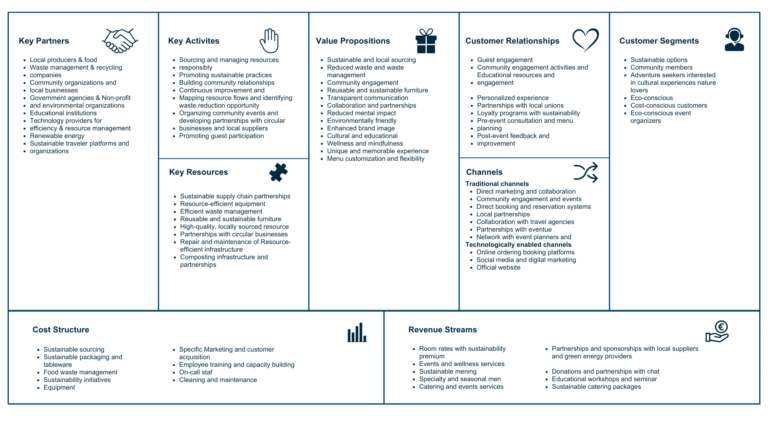
This presentation brings a further understanding on how you can apply this business model in practice.
Building on data gathered directly from businesses across the value chain, the project assesses the untapped potential for energy efficiency and renewable energy at each stage, from suppliers to service delivery. This enables businesses to better understand where improvements are possible and how these can translate into measurable benefits.
The project also develops a benchmarking tool that allows HORECA actors to compare their energy performance with sectoral references at value-chain level. This helps businesses identify where they stand, prioritise actions, and explore opportunities for collaboration with partners.
Use the tool yourself to have a better understanding of your value chain and the (i) energy requirement in your HORECA activities, (ii) energy requirement in transport activities, and (iii) energy requirements of the main suppliers
Benchmarking self-assessment tools:
Discover more about Business Models and Benchmarks through the following:
- Understanding the tools developed under this activity
- Sustainability Best Practices Report. A comprehensive report on sustainability best practices will be developed, based on an assessment of key resource flows across the HORECA supply chain.
- Report on the integrated economic model with NEBs. Development of an economic model that integrates life cycle management principles and evaluates the impact of non-energy benefits.
- Report on the untapped potential of energy efficiency and renewables.
- Report on the benchmarking activities.